

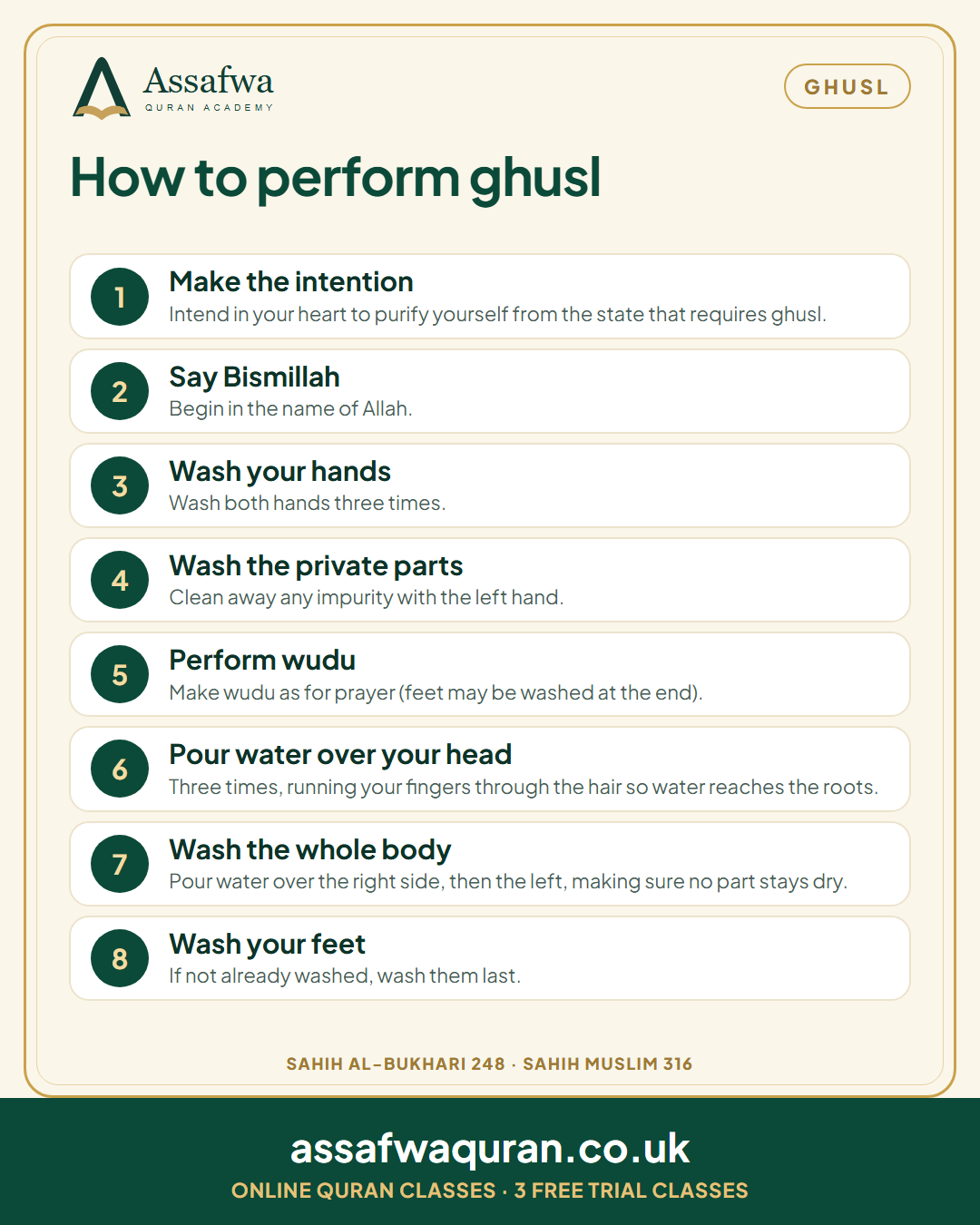
Ghusl is the full-body ritual bath. To perform it: make the intention, say Bismillah, wash your hands, wash the private parts, perform wudu, pour water over your head three times so it reaches the roots of the hair, then wash the whole body starting with the right side. This is the Sunnah method described by 'A'ishah (Sahih al-Bukhari 248). The minimum is that water reaches the whole body.
When is ghusl required?
- After sexual intercourse or any discharge that requires it (janabah).
- At the end of menstruation.
- At the end of post-natal bleeding.
- When someone accepts Islam (according to many scholars).
It is recommended before Jumu'ah (Sahih al-Bukhari 877) and the Eid prayers.
The Sunnah method
Make the intention
Intend in your heart to purify yourself from the state that requires ghusl.
Say Bismillah
Begin in the name of Allah.
Wash your hands
Wash both hands three times.
Wash the private parts
Clean away any impurity with the left hand.
Perform wudu
Make wudu as for prayer (feet may be washed at the end).
Pour water over your head
Three times, running your fingers through the hair so water reaches the roots.
Wash the whole body
Pour water over the right side, then the left, making sure no part stays dry.
Wash your feet
If not already washed, wash them last.
Described by 'A'ishah in Sahih al-Bukhari 248 and Sahih Muslim 316.
What makes ghusl valid
The essential part is that water reaches the entire body, including the hair roots. In the Hanafi school, rinsing the mouth and nose is also obligatory. Follow your madhab or local scholar on the details.
Teaching teenagers
Explain ghusl privately and simply before puberty. Our Nimaz & Deen course covers purification sensitively, and you can request a female teacher for girls.
References & sources
Quran references link to Quran.com and hadith references to Sunnah.com, so you can check every source. Spotted a mistake? Please tell us and we will correct it.